
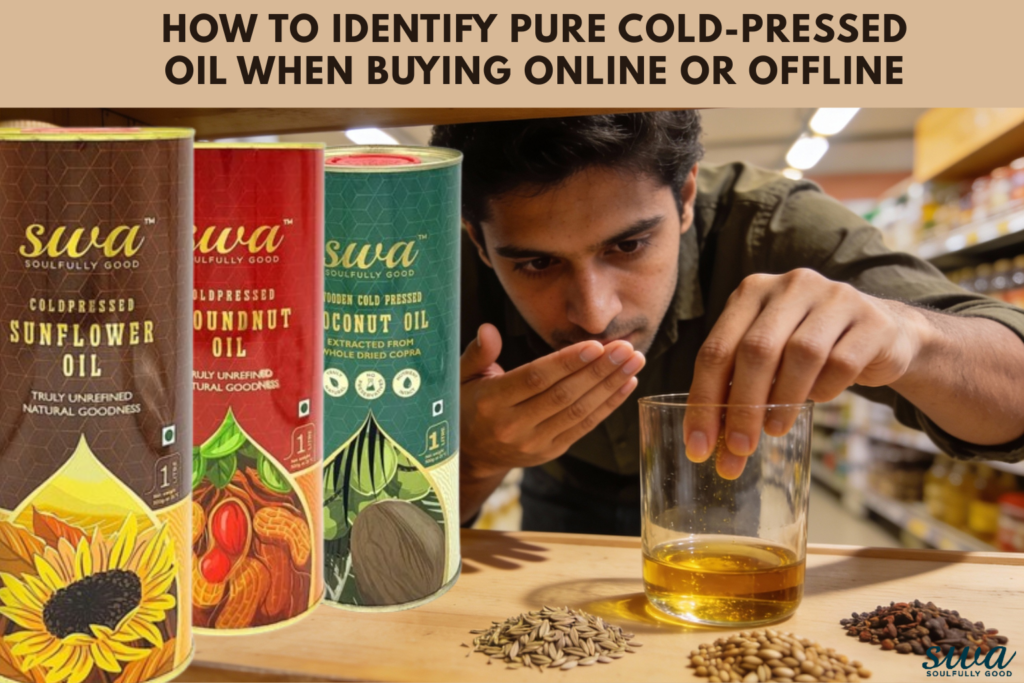
With growing awareness around health and traditional food practices, cold-pressed oils have found their way back into Indian kitchens. However, as demand rises, so does confusion. Many products today claim to be “cold-pressed,” “wood-pressed,” or “natural,” but not all of them truly follow traditional extraction methods.
Whether you are buying oil from a local store or ordering it online, knowing how to identify genuine cold-pressed oil helps you make informed choices. This guide explains what to look for, what to question, and what signs indicate purity, without relying on marketing buzzwords.
Start by Understanding What “Cold-Pressed” Actually Means
Cold-pressed oil is extracted by mechanically pressing oilseeds at low temperatures, without chemical solvents or artificial heat. In traditional methods, seeds are crushed slowly, often using wooden or stone presses, allowing oil to release naturally.
This slow process preserves the oil’s original nutrients, aroma, and flavour. Any oil that undergoes high-temperature processing, chemical extraction, or deodorisation does not fall under true cold-pressed oil, regardless of what the label claims.
Understanding this definition is the foundation for identifying authenticity.
Check the Extraction Method Mentioned on the Label
One of the first things to look for, both online and offline, is how the oil is extracted.
Pure cold-pressed oils clearly mention:
- Cold-pressed
- Wood-pressed
- Traditional or mechanical extraction
- No chemical processing
Vague terms like “naturally processed” or “premium refined” without explanation often indicate industrial methods. If the extraction process is not clearly stated, it is reasonable to question the purity of the oil.
Transparency in processing is a strong indicator of quality.
Observe the Colour and Appearance of the Oil
Pure cold-pressed oils usually have a natural, slightly uneven appearance. The colour depends on the seed used and the season of harvest.
For example:
- Groundnut oil appears golden to light brown
- Sesame oil has a deep amber tone
- Coconut oil may be clear when warm and solid white when cool
- Sunflower oil appears pale yellow
Extremely clear, colourless, or uniform-looking oils are often refined. Cold-pressed oils may appear slightly cloudy at lower temperatures, which is a natural sign of minimal processing.
Pay Attention to Aroma and Taste
A genuine cold-pressed oil carries the natural aroma of the seed it comes from. When opened, the oil should smell mild, nutty, or earthy, depending on the source.
Refined oils usually have little to no aroma because deodorisation removes natural compounds.
When tasted raw or lightly warmed:
- Cold-pressed oils have a distinct, natural flavour
- Refined oils taste neutral or flat
Strong artificial smells or complete absence of aroma both signal excessive processing.
Look for Minimal Ingredient Lists
Pure cold-pressed oil contains one ingredient only: the oil extracted from a single type of seed.
If the label lists:
- Additives
- Preservatives
- Antioxidants added externally
- Blended oils
Then the oil is not purely cold-pressed. Traditional oils do not require preservatives when processed and stored correctly.
Simple ingredient lists reflect confidence in the product’s purity.
Packaging Says More Than You Think
Packaging plays a crucial role in maintaining oil quality.
Pure cold-pressed oils are usually stored in:
- Dark glass bottles
- Food-grade metal tins
- Opaque containers that block light
Clear plastic bottles exposed to light can degrade oil quality over time. While packaging alone does not guarantee purity, careful packaging shows that the producer understands oil sensitivity and shelf stability.
Shelf Life Can Be a Clue
Cold-pressed oils generally have a shorter shelf life compared to refined oils because they retain natural components.
If an oil claims an unusually long shelf life without refrigeration or protective packaging, it may have undergone refining or chemical treatment.
Shorter shelf life does not mean inferior quality. It usually indicates minimal processing.
Price Should Reflect the Process
Cold-pressed oil extraction is slow, labour-intensive, and yields less oil per batch. This naturally affects pricing.
If an oil is priced extremely low while claiming to be cold-pressed, it raises questions about:
- Seed quality
- Extraction method
- Level of refinement
While price alone should not determine your choice, it often reflects the effort and authenticity behind the product.
Buying Cold-Pressed Oil Offline: What to Ask
When buying from physical stores or local sellers, asking the right questions helps identify genuine products.
Useful questions include:
- How is the oil extracted?
- Is it filtered or unfiltered?
- How often is oil produced in batches?
- Where are the seeds sourced from?
Sellers dealing in authentic cold-pressed oils are usually open and knowledgeable about their process.
Buying Cold-Pressed Oil Online: What to Look For
Online buying requires more careful reading since you cannot see or smell the oil beforehand.
Check for:
- Clear product descriptions explaining extraction
- Educational content around oil usage
- Information about sourcing and processing
- Customer reviews mentioning aroma, taste, and texture
Websites that focus on explaining their process rather than only selling usually indicate credibility.
Sediment Is Not a Defect
Some cold-pressed oils contain fine natural sediment, especially if they are minimally filtered. This is not a defect.
Sediment indicates that the oil has not been aggressively filtered or chemically treated. Gently shaking the bottle or allowing it to settle naturally is enough.
Perfect clarity often comes at the cost of nutrients.
Seasonal Variation Is Normal
Oil colour and aroma may vary slightly across batches depending on seed quality, harvest season, and climate. This variation is common in traditional oils.
Consistency across every batch often suggests heavy processing designed to standardise appearance rather than preserve nature.
Certifications Are Helpful, Not Absolute
Food safety certifications confirm hygiene and compliance, but they do not always guarantee traditional extraction.
While certifications add credibility, they should be considered alongside transparency, aroma, appearance, and processing details.
Traditional purity cannot always be captured fully by labels alone.
Why Trust and Process Matter More Than Claims
Ultimately, identifying pure cold-pressed oil comes down to trusting producers who prioritise process over volume.
Brands that talk openly about:
- Traditional extraction
- Small-batch production
- Seed sourcing
- Careful storage
tend to produce oils that behave naturally in cooking and retain their original qualities.
The goal is not perfection in appearance, but honesty in production.
Final Thoughts
Choosing pure cold-pressed oil requires a shift in mindset. Instead of looking for uniform colour, neutral smell, or long shelf life, the focus should be on authenticity, transparency, and natural variation.
Cold-pressed oils are meant to feel alive, carrying the character of the seed, the process, and the tradition behind them. Once you learn what to look for, identifying genuine oil becomes intuitive, whether shopping online or offline.
Making this informed choice supports not only better cooking, but also a return to food practices that respect quality over convenience.